
Analyzing Carnell Tate’s Ceiling Case for Fantasy Football in 2026
Carnell Tate is the WR29 off the board on Underdog. The analytics tell us that he’s one of the most efficient, sure-handed Xs to enter the league in recent years. In Tennessee, he’s paired with a second-year quarterback whose strengths mirror his own, in a scheme that rewards an alpha boundary receiver who wins at the catch point. In our view, Tate’s draft cost is reasonable, but doesn’t sufficiently account for his ceiling case.
The Value Gap
ESPN’s Mike Clay projects Tate as WR27 in half-PPR scoring (172 points on 78 catches, 1,068 yards, and 5 touchdowns). Our argument isn't that Tate is cheap. It's that WR29 accounts for a reasonable rookie-year median and but under indexes on his upside.
In our view, Tate has one of the cleanest paths to a true ceiling season of any receiver currently being drafted in his range. Our position rests on three things we believe the market is underrating:
He's a better prospect than his college counting stats suggest
He’s a great stylistic fit with Cam Ward
His playcaller has a history of maximizing his best characteristics
***
We Think Tate is an Elite Receiver Prospect
The Titans took Tate No. 4 overall. He was the consensus WR1 of the class. He extends Ohio State's streak to five straight drafts with at least one first-round receiver,
The common criticism is that he was never his own team's WR1, even in his draft year, playing alongside Jeremiah Smith, who many evaluators consider a generational prospect. Ohio State's receiver room has also historically been built on relatively equitable distribution rather than force-feeding one player.
As a Junior, Tate commanded a 23.3% share of Ohio State's receiving yards, accumulating 51 catches, 875 yards (17.2 per catch), and 9 touchdowns across 11 games:
Smith per game 2025 stats (13 games): 6.7 rec, 95.6 yards, 1 td
Tate per game 2025 stats (11 games): 4.6 rec, 79.5 yards, .82 td
And his underlying analytical profile is more compelling:
He separates extremely well against man and press man coverage. PFF's draft guide credits him with 90th-percentile separation metrics both overall and against single coverage. Per Tate’s Reception Perception profile, his 77.3% success rate vs. man coverage (89th percentile) and his 75% success rate (84th percentile) are elite.
He has all-time hands and excels in contested catch situations. Tate posted a zero-drop season on 66 targets in 2025. At the same time, his contested-catch rate climbed every year (50% to 60% to 85.7%) of his college career. That contested success rate in his final year at OSU is territory only Justin Jefferson and Jaxon Smith-Njigba have bettered among Power Four receivers with 10-plus contested targets since 2019.
The honest knock: Tate is a below-average yards-after-catch player, going down on first contact on 73% of his "in space" reps in his Reception Perception sample. He’s probably not a candidate to bust a bubble screen or take a shallow crosser to the house, and it’s a fair point that has him priced as a midrange WR3, instead of, say, in the WR15-20 range. But it matters less to the bet we're making, because Tate's best traits are winning downfield and at the catch point, not making defenders miss after the catch.
***
Where Tate Ranks Among Recent First-Round Receivers
At face value, Tate's raw box score reads modest for a top-four NFL draft pick. The efficiency numbers make a stronger case for him being genuinely elite.
In 2025, Tate posted 3.02 yards per route run and 2.74 yards per team pass attempt, 12th among 200 FBS receivers. If we narrow the field to the sport's best competition, he grades even better: fifth among 143 Power Four receivers with 50-plus targets, where he also led the group in passer rating when targeted at 151.8. Both of those numbers mark big leaps from 2024, when Legendary Upside charted him at 1.91 YPRR and 1.70 yards per team pass attempt in a less prominent role.
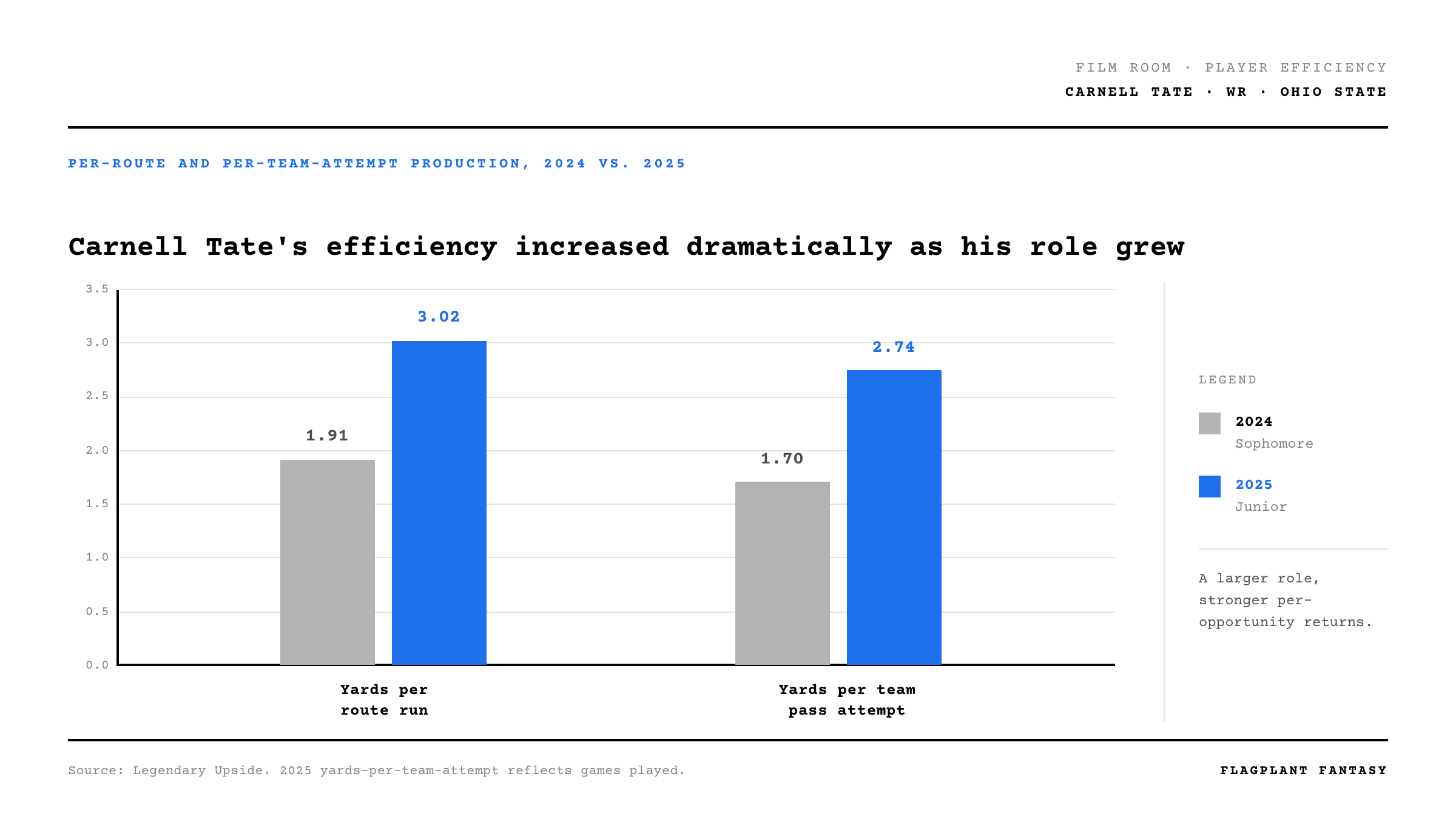
Tate's amplified efficiency in a larger role is an auspicious signal of what he projects to be at the next level.
Being outproduced in an Ohio State receiver room is a rite of passage, and as a Junior, Tate was the more efficient player of the recent cohort under similar circumstances:
In his final year at Ohio State, first-round pick Emeka Egbuka was also outproduced by Jeremiah Smith and posted a 2.51 YPRR.
In 2021, top-11 NFL picks Garrett Wilson and Chris Olave were both outproduced by Jaxon Smith-Njigba, and neither surpassed Tate’s Junior year route-running efficiency in their final college seasons.
Tate’s closest pre-draft comps are players like Drake London, Mike Williams, Tetairoa McMillan, Rome Odunze, and Chris Olave. The most instructive comparison for a rookie-season bet is what this exact archetype has produced when it landed in a clear role. Two boundary-X receivers in Tate's mold hit immediately as rookies: McMillan and Olave each finished WR24 in half-PPR points per game in their debut seasons, and McMillan did it on a run-heavy Carolina offense with shaky quarterback play.
What separates the archetype's ceiling outcomes from its Mike Williams floor is the ability to uncover against tight coverage, and that's where Tate's film pushes him up: 89th-percentile success rate against man, 84th percentile against press, and a best-in-class 85.7% contested-catch rate.
The versions of this archetype that struggled early, like Odunze, tended to be the ones buried in a committee or splitting an alpha role rather than owning it. That distinction is key, because Tate joins Tennessee as the clear best pass-catcher on the roster, which is the cleanest such claim among the receivers in his current Underdog draft range:
Brian Thomas Jr. has to re-establish himself over Parker Washington and Jakobi Meyers in a muddy Jacksonville room.
Rome Odunze shares an ascending Chicago offense with Luther Burden and Colston Loveland.
Christian Watson competes in Green Bay's committee with Jayden Reed and Matthew Golden.
***
The Cam Ward Fit Is Intriguing
Tate landed with a quarterback whose route-by-route profile lines up nicely with his own.
Let’s start with what Ward did as a rookie. It wasn’t pretty:
Per Alfredo Brown's Reception Perception charting, Ward lived at and around the line of scrimmage (LOS). Screens (14.2% of his charted attempts), slants (14.2%), and checkdowns (13.4%) accounted for more than 40% of his throws, and his success-rate heat map is a wall of yellow right at the line: 76.8% to the left, 82.3% over the middle, 83.3% to the right.
The further downfield he went, the worse it got. He hit 50% on posts, and 27.3% on corners, with a deep-right zone that cratered at 25%. He averaged just 5.9 yards per attempt, a bottom-of-the-league mark.
The 2025 Titans' receivers couldn't get open downfield, so Ward threw deep on a class-low 9.4% of attempts despite posting the best nine-route success rate (41.9%) among rookie signal callers. He also had the highest volume of third-and-long situations Brown charted in the class.
Ward does have one clear strength beyond the line of scrimmage, and it's the curl: an 86% success rate on 13.4% of his throws, the best mark in his profile outside of screens and flats. His second-best area is the intermediate middle, where his heat map reads 66.7%, comfortably his strongest non-LOS zone.
Per Matt Harmon’s charting, Tate’s two best routes are the curl (84.1%) and the dig (82.6%), with the flat and post right behind at 85.7% and 80% success rates respectively. The curl is also the route he ran most often as a Junior, accounting for 24.9% of his charted routes. His nine route success came in at a healthy 68.6% on nearly 20% volume.
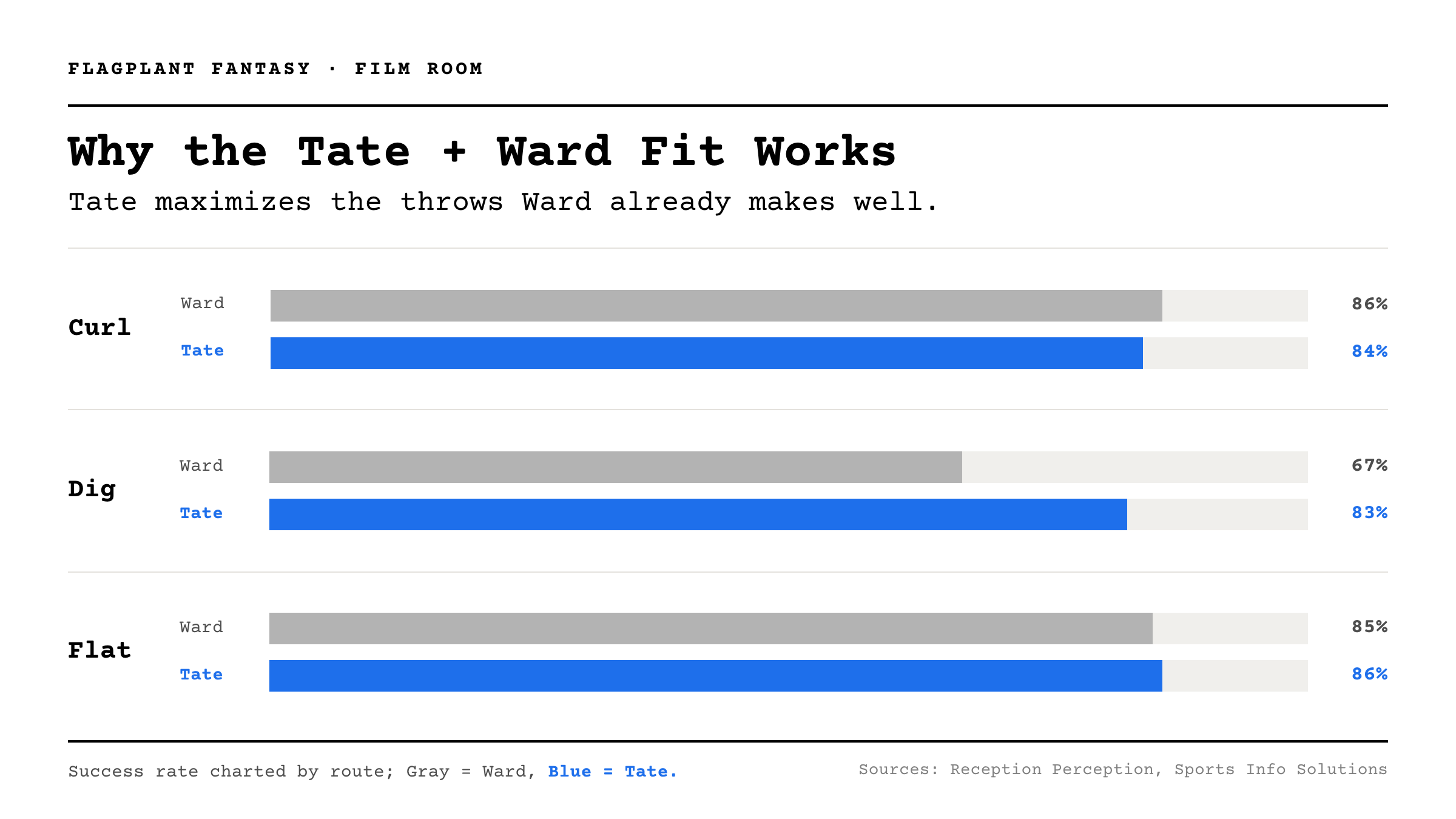
The dig is where it gets interesting. Ward's intermediate-middle success (66.7%) is his best non-LOS zone, yet he threw digs on only 5.7% of his attempts. He was competent in the middle of the field and barely targeted it, because he didn’t have pass catchers who could win there. The dig is one of Tate’s best routes at 82.6% on 13% volume.
Tate and Ward do share a soft spot against zone coverage. Per Reception Perception charting, Tate's zone success rate (76.5%; 32nd percentile) is the one clear weakness in his separation profile. Ward's heat map shows cold spots in the deep-middle and deep-right.
While Reception Perception grades his zone separation below average, Sports Info Solutions credited Tate with the best positive play percentage against zone (67%) among 54 receivers in their draft matrix. Both are true because they measure different things. Reception Perception measures whether he created separation. SIS measures whether the play produced a positive outcome.
Because his hands, body control, and contested-catch ability are so good, Tate consistently produced positive plays against zone coverage at the best rate in his class.
Ultimately, we believe Tennessee spent the fourth overall pick on Tate to bring in a receiver who maximizes the throws Ward already makes well and unlocks the part of the field he's talented enough to attack, but hasn’t had the supporting cast to do so at volume.
***
Brian Daboll Is the Amplifier
The most important change in Tennessee could be how Daboll’s presence optimizes for Ward's arm talent. In 2025, Daboll's Giants threw deep at the fifth-highest rate in the NFL (12%) and logged the sixth-highest air yards per attempt (8.7), while the Titans under the previous staff ranked bottom-10 in both. That schematic wrinkle is part of what we believe will feed Tate downfield.
Daboll's offense is also typically built to feature a movable alpha receiver, prioritizing concepts rather than fixed assignments so he can align his best pass catcher anywhere and hunt matchups. When he's had that alpha, the volume has been enormous:
Stefon Diggs in his first Daboll season led the NFL in targets, receptions, and receiving yards.
The more recent and more relevant proof: Malik Nabers. As a rookie, he posted 179 targets, 109 receptions, and 1,204 yards catching balls from Daniel Jones, Drew Lock, and Tommy DeVito.
Daboll also reportedly likes what he sees from Tate so far in offseason workouts. In a recent Sports Illustrated article, Daboll, “...we've thrown a lot at these guys, and he's picked it up extremely well. I've done this for a long time. In terms of picking it up, he's [Tate’s} been one of the top of the skill positions.” We think that’s a pretty good sign for the pair’s potential synergy.
***
What Could Go Wrong
Tennessee's receiver room isn’t strong, but Wan'Dale Robinson signed for $17.5 million per year and saw 140 targets in each of the last two seasons. Daboll knows him from their time in New York. Calvin Ridley is a former All-Pro, although it’s been several years since he’s been a relevant player. Elic Ayomanor and Chimere Dike… caught passes as rookies in 2025.
Tate commanding alpha volume immediately in year one isn't guaranteed, but Robinson is a slot receiver who works the short and intermediate areas of the field. Tate is an outside X. They won’t compete for the same targets, and they produce in very different ways. Robinson is a high-volume, low depth, low-value target earner: he has just 9 receiving touchdowns on 389 career targets.
We think Tate will own the boundary and the deep third, while running a healthy diet of intermediate inbreakers, which is the role much more likely to generate the yards, touchdowns, and chunk plays that produce fantasy points. Even if Robinson leads the team in targets and catches, Tate likely leads in both yardage and touchdowns. We think he could certainly lead the team in targets and catches, too.
***
Our Carnell Tate Draft Strategy
Tate is, in our opinion, an elite talent, a near-perfect stylistic fit for an ascending quarterback, and the featured alpha in an offense that will amplify his strengths.
The market has him priced as a fair-value rookie. What separates him from the other receivers in his ADP range is the cleanest claim to being his own team's No. 1, on a passing game with room to grow.
We're drafting Tate at WR29 a lot. I have him on 14% of my Underdog teams so far. And the correlation around him is where this gets fun. Cam Ward is going around pick 140 on Underdog. If you believe Tate excels in year one, you should probably also buy into Ward taking a major step to help make it happen.
Tight end Gunnar Helm goes around pick 180, TE26 off the board. We think Helm is the most well-rounded tight end on the roster and a real bet to lead the position group in snaps, which makes him a dirt-cheap third piece of a Titans passing-game correlation play.