
The Case for Ashton Jeanty as a First Round Fantasy Football Pick
Ashton Jeanty is RB5 on Underdog, going at pick 11 on average. He's valued at a premium despite coming off an inefficient, all in all disappointing rookie year in Las Vegas. A deeper look at the analytical profile coupled with the player’s immense talent and a drastically improved environment tell us he’s among the highest upside profiles available at the 1-2 turn in drafts right now.
Contextualizing Last Year’s Environment
Jeanty's rookie box score is hideous: 3.7 yards per carry and a half-PPR per-game RB17 finish for a player drafted as a fantasy cornerstone.
It’d be hard to blame you for seeing that and deciding he’s not worth a premium pick in 2026 drafts. We simply can’t do that after watching the tape and looking under the hood.
The 2025 Raiders were one of the worst environments imaginable. Las Vegas finished 31st in the NFL in EPA per play, and by FF Dataroma's model the second-worst offense by EPA per play since 2017.
They went 3-14, The offensive line ranked 22nd in both run block and pass block win rate and near the bottom of the league in all meaningful rushing metrics.
Jeanty's entire job as a rookie was to create yards that literally did not exist, and he did, at a level almost no back in the league matched.
***
Jeanty’s Underlying Profile Is Elite
Pulling Jeanty's 2025 charting from Fantasy Points Data, his profile’s shape is that of a back who produced like a star while running behind a generously holey sieve.
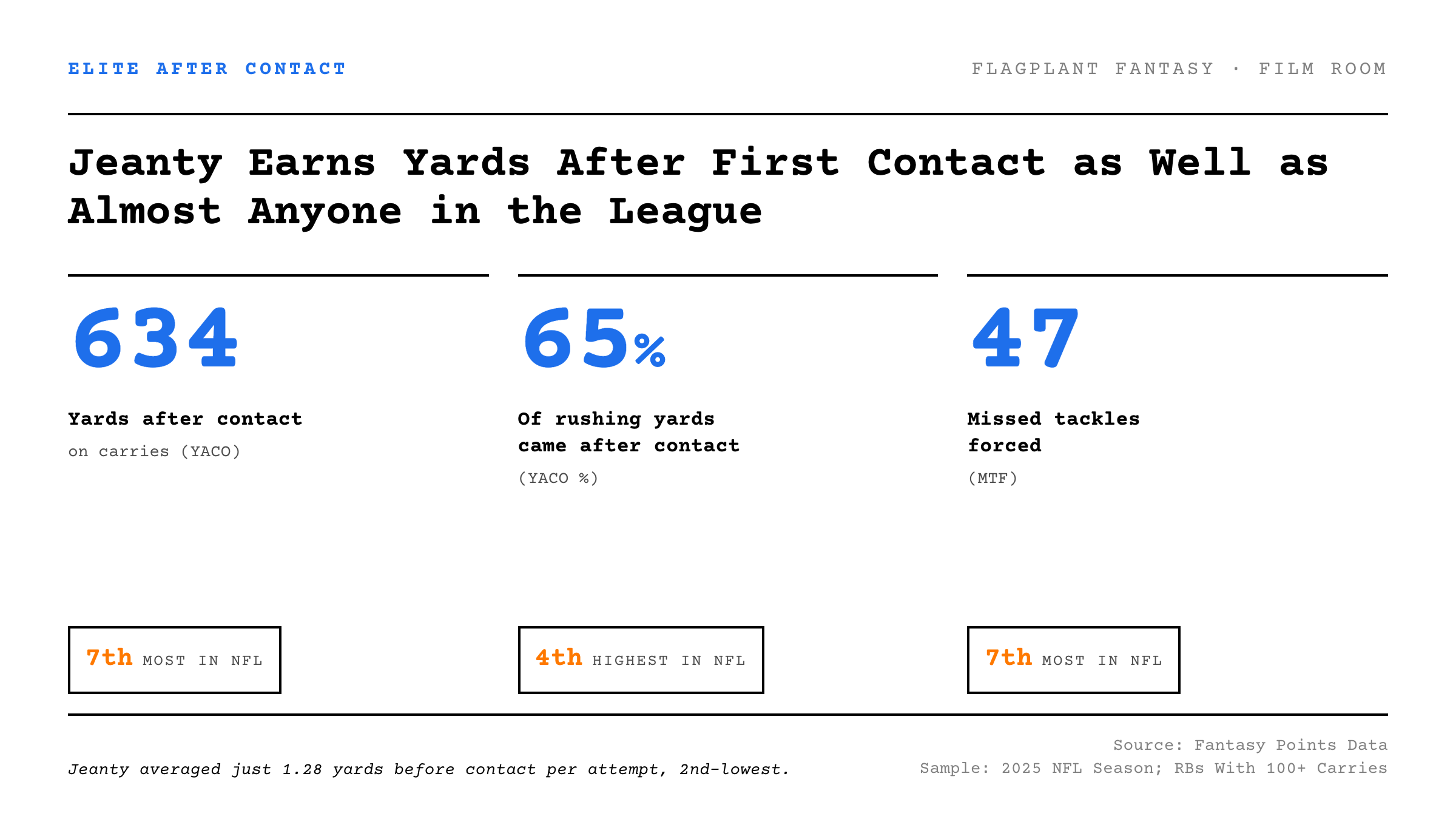
Jeanty averaged just 1.28 yards before contact per attempt, the second-lowest mark among ball carriers with 100-plus carries. He was hit at or behind the line on essentially every rush. Jacob Gibbs' analysis puts that number in its full historical context: among 115 running backs with 250-plus rushes in a season from 2012 to 2025, Jeanty's 0.60 yards before contact per rush ranked 115th. Dead last, across a 14-year sample. The consequence shows up in a 53.4% stuffed run rate, the second-highest in the league.
But he did some pretty awesome stuff in spite of that:
634 yards after contact on carries, 7th-most in the NFL; 65% of his rushing yards came after contact, 4th-highest.
Gibbs' data further sharpens the point: on runs where the line gave Jeanty at least a yard before contact, he posted 3.4 yards after contact per rush, the best mark in the NFL, ahead of even Bijan Robinson at 2.8.
On that same split, Jeanty and Bijan were statistical doppelgängers: identical 71% success rates and 25% missed-tackle-forced rates; Bijan is the best back in football, and the guy on a 3-14 team produced comparably when his blockers gave him any sort of a lane to work with.
46 missed tackles forced, 6th-most in the league. He was the entire Raiders' explosive-play generation, with Brock Bowers missing a huge chunk of the season.
262.6 expected fantasy points, 7th-most among all backs, on a 25.1% share of his team's total expected fantasy points, 4th-highest.
The volume and the role were already elite. The baseline efficiency was dramatically suppressed by what was happening in front of (and around) him.
Jeanty’s 2025 touchdown rate rounds out the positive regression case. He scored on just 1.9% of his touches, the 9th-lowest rate among backs with 100-plus carries. That’s a restrained number on top of elite volume and tackle-breaking ability, and he’s a textbook regression candidate as the offense inevitably improves around him.
***
The Film Agrees
Turn on Jeanty’s tape and you’ll see elite contact balance, premium lateral agility, high-end vision (especially on outside zone runs), and a strong pass-catching skillset. All the traits we want and that are predictive of producing fantasy points.
James Koh's charting at Reception Perception clocked Jeanty's broken tackle rate at 30.3%, the 3rd highest he’s charted across the past two seasons, with the only superior marks belonging to Bijan Robinson in 2024 and 2025.
Koh's charting also tracked a 29% unblocked defender rate against Jeanty, the second-highest he has logged in two seasons, and a 32.8% run stuff rate. Ugly stuff.
The most telling mark: Jeanty posted a 66.7% success rate on outside concepts, a hair behind Bijan's 67.3%. Reception Perception classifies anything above 65% as “star” territory.
In our view, Jeanty’s raw talent is elite.
***
The Situation Is Massively Improved
The bull case for Jeanty exploding in 2026 isn’t hard to make since the Raiders spent the offseason optimizing (or at least deliberately trying to improve) the environment around him:
Better coaching. Klint Kubiak takes over as head coach and play-caller, coming off a Super Bowl with Seattle where his offense finished 10th in EPA per play, 6th in rushing yards, and 2nd in total points. Kubiak runs an efficient, run-heavy, wide-zone West Coast scheme, and that specific detail is the most important situational fact in this entire profile.
The scheme fit is ideal. Jeanty averaged 4.1 yards per carry on zone concepts last year against just 3.02 on man/gap concepts, and 63.2% of his rookie carries were already zone runs. Kubiak's offense has historically leaned on the rushing concepts Jeanty excels in.
The offensive line is better. Las Vegas made center Tyler Linderbaum the highest-paid interior lineman in NFL history; he graded as PFF's 4th-best run-blocking center in 2025. Left tackle Kolton Miller, elite when healthy, returns after a injuries limited him to four games last year.
Kubiak and the front office have made the line the centerpiece of the rebuild. Two proven studs anchor the interior and the left edge. The other three spots (left guard, right guard, right tackle) are genuine training-camp competitions, and the unit still projects as average to below-average as a whole according to Mike Clay, Sharp Football Analysis, and others. But even going from the league's worst line to a half-decent one would be a big boon to Jeanty's breakout potential.
Better quarterback play. The Raiders signed Kirk Cousins and drafted Heisman winner Fernando Mendoza first overall. Reporting points to Cousins starting Week 1, with Mendoza easing in later in the season. For Jeanty, the week-1 starter matters less than the collective upgrade. A competent signal caller, whoever it is, stops defenses from selling out against the run the way they did against the inefficient turnover machine that was Geno Smith and the 2025 Raiders. A healthy Brock Bowers returning as a genuinely elite pass-catching option is part of the bet, too.
***
Jeanty’s Receiving Profile Is Sneaky Good
The most underrated part of Jeanty's game is what he does as a receiver.
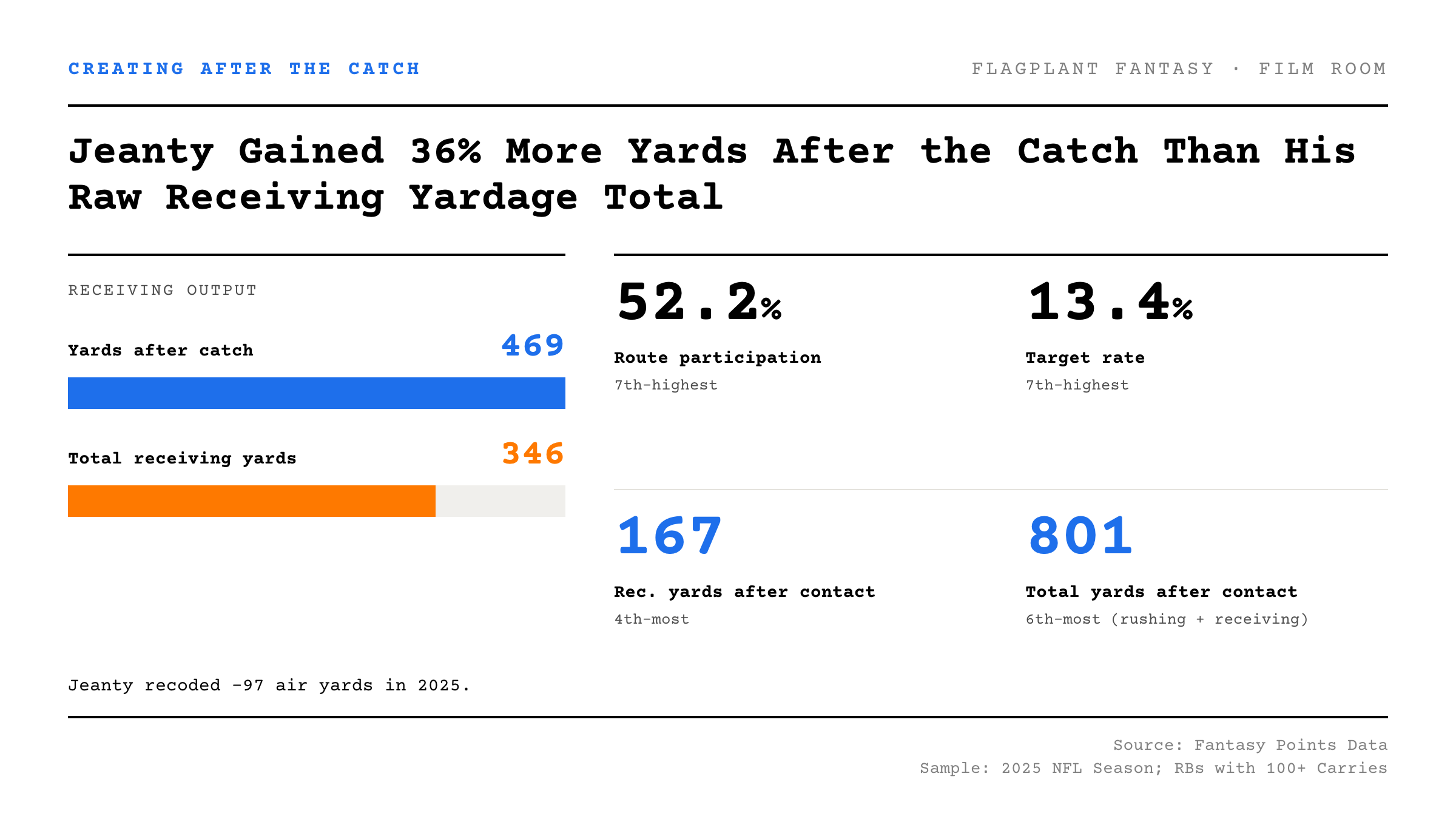
Jeanty ran a route on 52.2% of the Raiders' drop backs (7th-highest rate among backs) and commanded a 13.4% target rate (also 7th).
He produced 346 receiving yards on that usage. Here’s the absurd part, from Fantasy Points Data: he posted 469 yards after the catch on negative-97 air yards... Meaning Jeanty gained more yards after the catch than his receiving total.
He added 167 yards after contact on receptions, 4th-most in the league among ball carriers with at least 100 carries. Combining rushing and receiving, Jeanty piled up 801 yards after contact, 6th-most among that same group.
In half-PPR best ball, a back with this prominent of a receiving role carries a floor that pure early-down runners simply don’t, and he built it while the passing game was at its theoretical worst. Kubiak's scheme and functional quarterback play are likely to make his receiving output even more efficient.
***
What Could Go Wrong
Jeanty as a top-12 fantasy football pick isn’t a risk-free bet.
The offensive line is improved but uncertain. If the wrong combinations win starting jobs, Jeanty could again see more backfield contact than his talent deserves. The line going from worst-in-league to average is the bet, and it’s very much a bet, not a certainty.
There’s also the stuffed-run-rate flag. Jeanty was stuffed on 53.4% of his carries, the 2nd-worst rate in the league. The bull will broadly attribute that to bad play calling and poor blocking, and the yards-before-contact data supports that position. However, if some meaningful share of it traces to Jeanty's own vision or patience between the tackles, the improvement could be less drastic than the "fix the environment" thesis assumes. Koh's charted 41.6% inside success rate is the main number in Jeanty’s profile that gives the bear case legitimate credence.
In our view, the yards-before-contact and yards-after-contact splits are so extreme that they isolate the environment as the overwhelmingly influential variable: a back who leads the NFL in yards after contact when given a yard of room to run, while ranking dead last in getting that yard of running room across 14 years of data, tells us where the problem likely lived.
***
Our Ashton Jeanty Draft Strategy
Jeanty is an elite talent, coming off a confusing rookie year that has done nothing to lower an already premium fantasy cost, which means the edge here is not that he's underpriced at face value.
The edge is that his ceiling at this price is worth betting in at the 1-2 turn.
We're taking Jeanty often at the back of Round 1 and top of Round 2. Among the cohort of running backs going in that range, his combination of guaranteed volume (ESPN’s Mike Clay projects him for 368 total opportunities and 87 targets in 2026), elite contact balance and lateral agility, plus a scheme built to accentuate his strengths, an offensive environment with tons of room to improve, and potential touchdown-regression equity gives him a uniquely high ceiling.
In best ball, you're drafting for outcomes that win tournaments, and he’s the kind of player we’re betting on.
One more edge for Underdog drafters: one of the cheapest correlations in the league runs through the Raiders offense. Jalen Nailor and Tre Tucker are both drafted in the 148-153 range on averaage. If you believe Las Vegas' offense takes the leap this profile is built on, pairing Jeanty with a cheap share of Nailor or Tucker captures the same rising tide at nominal cost.
The floor already came through last year in the worst situation imaginable, and Jeanty was still the half-PPR RB13 on RB7 usage. We’re projecting a jump into the top-5, and are drafting him accordingly.